Events
Navigate: Content > Search Content or + Icon > Events
The Events tab is used to configure event-specific settings for event content, including schedule, location, enrollment rules, participant information, and notifications.
This tab is only visible for events, not for learning paths or single course content.
Event information marked with an eye icon is visible to learners in the user portal.
In this section
- Event setup – define the main event details shown to learners and administrators.
- Online and classroom details – configure virtual or physical event location information.
- Cost and waiting list – configure event cost calculation and waiting list offer behavior.
- Enrollment and capacity – control enrollment limits, deadlines, waiting list behavior, and approvals.
- Global waiting list and event participants – review learners waiting for a suitable event and participants across event sessions.
- Visibility – decide whether the event is available in the user portal event calendar.
- Event detail operations – manage participants, attendance, cost, manual enrollment, and event cancellation.
- Event notifications – understand which notifications can be sent for event activity.
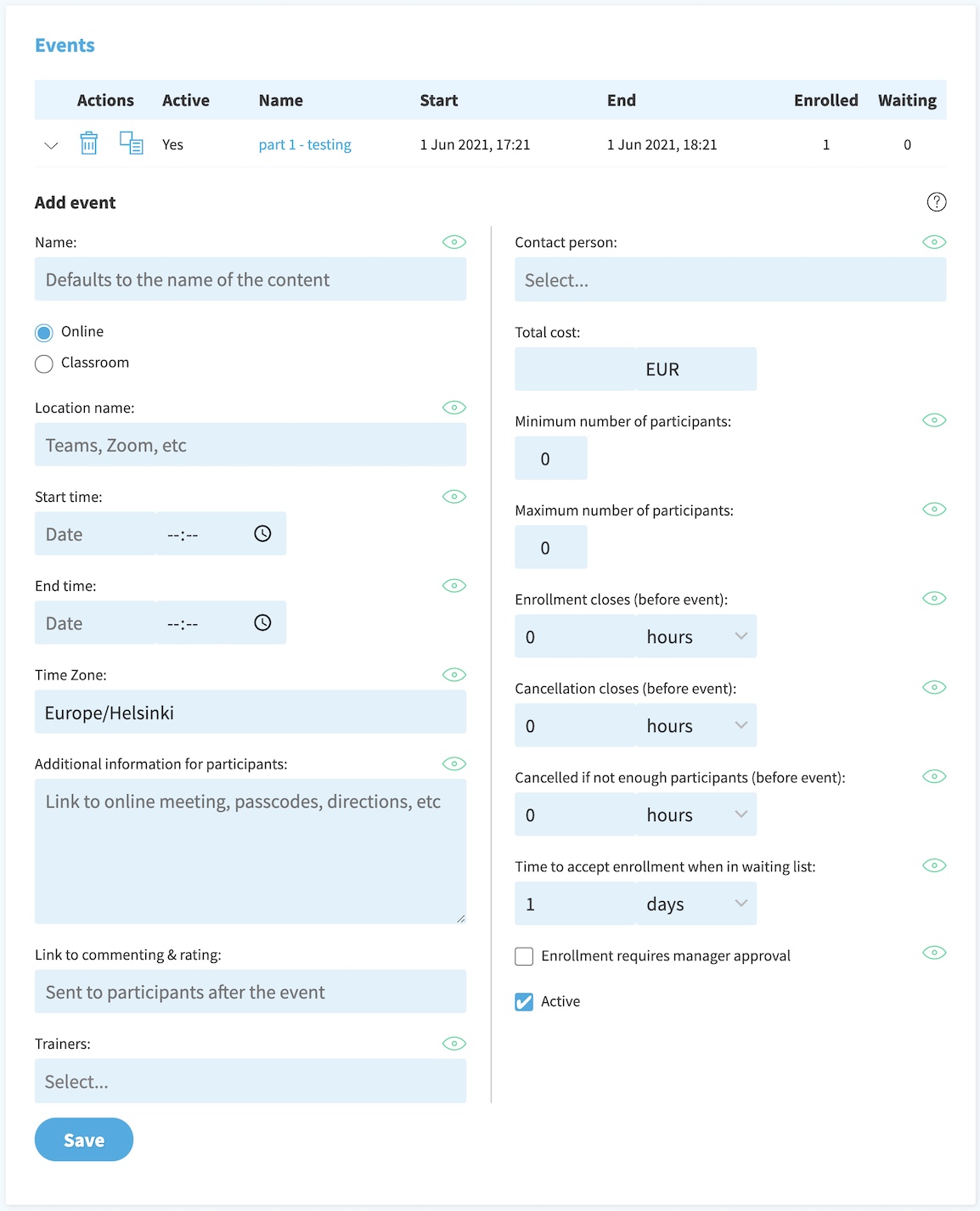
Event setup
Use the Events tab to define the core event information:
- Name – the event name shown to learners and administrators.
- Event page description – learner-facing description shown on the content page.
- Event type – whether the event is an online event, a classroom event, or both.
- Time slot type – whether the event has a Single time slot, Multiple time slots, or No time slots.
- Start and end time – the event date and time for a single time slot.
- Time zone – the time zone used for the event schedule.
- Dates and times – for multiple time slots, the table contains Start, End, Name, and Location for each slot.
- Meeting link – the link to the online meeting.
- Additional information for participants – learner-facing event details, such as enrollment information, event agenda, or target audience.
- Additional information is provided outside the LMS – removes the notice that private event details are available on the event page and in enrollment confirmation emails.
- Link to commenting and rating – an external feedback or evaluation link, if feedback is collected outside the LMS.
- Send a reminder for commenting and rating 3 days after completion – sends a feedback reminder after completion.
- Send the link to everyone enrolled regardless of completion status – sends the feedback link to all enrolled learners, not only to those marked as completed.
- Event and waiting list enrollment confirmation message – adds text to enrollment confirmation emails, including waiting list emails.
- Trainers – people leading the event.
- Contact person – the main event contact.
- Total cost – internal cost information. This is not visible in the user portal.
The preview link opens the learner-facing event page so you can review how the event will appear in the user portal.
Online and classroom details
Online event details identify the virtual location or platform used for the event, such as Teams.
Classroom event details identify the physical location. The location can be selected from existing locations or defined with details such as location name, address, room, city, region or state, and country.
Cost and waiting list
Event cost settings can record participant-facing and internal cost information:
- Total cost for internal use – internal event cost information. This is not visible in the user portal.
- Cost type – whether cost is recorded Per participant or Per event, split by participants.
- Cost – the participant-facing cost value based on the selected cost type.
- Cancellation does not create cost before event – how long before the event a cancellation can still avoid creating cost.
Waiting list behavior controls how a free place is offered:
- Offer new spots one by one according to registration order – offers a place to the next learner in the waiting list.
- Offer new spots to everyone at once, fastest gets the spot – offers the place to all waiting learners and gives it to the first learner who accepts.
Enrollment and capacity
Event enrollment settings control when learners can join or leave the event and what happens when the event reaches capacity.
- Minimum number of participants – the minimum number of participants needed for the event to take place.
- Maximum number of participants – the event capacity. When the event is full, additional learners can be placed on the waiting list.
- Enrollment closes before event – when learners can no longer enroll.
- Cancellation closes before event – when learners can no longer cancel their own enrollment.
- Cancelled if not enough participants before event – when the event is automatically cancelled if the minimum participant count is not met.
- Explicitly notify managers about unapproved enrollments before event – when managers are reminded about enrollment requests that still need approval.
- Time to accept enrollment when in waiting list – how long a learner has to accept an offered place from the waiting list before it is offered to the next learner.
- Enrollment requires manager approval – sends the learner's enrollment request for manager approval before the enrollment is confirmed.
- Device range – limits the event to a configured device range when device ranges are used.
- Track attendance – controls whether attendance is tracked for the event.
Global waiting list and event participants
The course-level Waiting list tab shows the global waiting list for the training. It contains learners who want to take the training but have not found a suitable event or found only full events.
Learners on the global waiting list are automatically notified when a new event is added, and they are removed from the list when they complete an event. Administrators can also add users with Enroll to global waiting list, cancel waiting-list entries, include cancelled entries, and download the list.
The course-level Enrolled tab shows participants and waiting-list entries across the training's events. The table includes columns such as Event, Start, Name, Type, and Status. The Advanced action can show whether a user is enrolled in any event, and Download exports the current results.
Visibility
Active events can appear in the user portal event calendar. If an event is inactive, learners cannot enroll in it from the user portal.
Inactive events and archived content do not send event notifications.
Event detail operations
Opening a specific event shows tabs such as Enrolled, Waiting list, Cost, Options, and General information, depending on permissions and event settings.
The Enrolled tab lists registered participants. When Track attendance is enabled, attendance can be marked as Completed, Incomplete, Failed, or Absent. Participant actions can include Cancel, Move to waiting list, and Force enroll.
The Waiting list tab lists learners waiting for that event. Available actions can include Cancel and Enroll.
The Bulk update attendance section contains Download spreadsheet and Upload spreadsheet. Download the spreadsheet for marking attendance, then upload the completed file back to the LMS. Do not modify or remove the hidden enrollment column. When the file is uploaded, enrollments that are not marked as completed are marked as absent, and the upload summary shows found enrollments, status updates, certificate ID updates, and errors.
The Cost tab shows event participant cost data when the event has a cost value and the administrator has permission to edit event cost information.
The Options tab can include Add participants and Cancel event. When adding participants to an event that requires manager approval, Requires manager approval controls whether the manually added enrollment still needs approval. Cancelling an event notifies enrolled learners and cannot be reversed.
Event notifications
Events can trigger several notifications. The schedule describes when the LMS checks whether the notification should be sent.
| Name | Description | Schedule |
|---|---|---|
| Event registration notification | Sent after a learner enrolls in an event or joins its waiting list. | Quarterhourly |
| Event registration cancelled | Sent after an enrollment is cancelled. | Quarterhourly |
| Event enrollment offer | Sent when a place becomes available and the learner must accept or reject the offer. | Quarterhourly |
| Event modification notification | Sent to enrolled learners when important event data changes. | 5 minutes after modification, or 1 minute when the change is made less than 30 minutes before event start |
| Event about to start notification | Sent to enrolled learners 30 minutes before the event starts. | Quarterhourly |
| Event cancellation notification | Sent after an event the learner was enrolled in is cancelled. | Quarterhourly |
| Event feedback notification | Sent after the event day asking participants to provide feedback. | Daily |
| Event quiz invitation | Sent to participants when the event has a quiz they may need to complete. | Quarterhourly |
| Event waiting list notification | Sent after a learner joins the global waiting list for an event. | Quarterhourly |
| Event unmarked attendance notification | Sent to trainers and content owners when event attendance has not been marked. | Trainers: within an hour after the event and weekly. Content owners: 3 days after the event. |
| Manager event participant failure notification | Sent to managers when a team member cancels an enrollment the manager had approved. | Hourly |
After an event is cancelled, only the event cancellation notification is relevant; other event notifications are not sent.
Notification schedules define when the LMS checks whether a notification should be sent.
For example, if you cancel an enrollment and then deactivate the event before the quarterhourly notification check runs, the enrollment cancellation notification will not be sent because the event is no longer active.
If the event itself should no longer happen, cancel the event instead of cancelling individual enrollments and then deactivating the event. This notifies enrolled learners and prevents new enrollments.