Content and Materials
Navigate: Content > Search Content or + Icon > Content Management
The Content and Materials tab manages the files and links connected to the content.
Use this tab for the actual learning content, supporting materials shown on the content page, and source files that should be kept with the content record.
In this section
- File types – understand the difference between content, additional materials, and source files.
- Contents and materials list – review uploaded files and their key metadata.
- Uploading materials – add files or links and see supported formats.
- Material access and behavior – control link opening, additional-material visibility, and active state.
- Active files – control which uploaded files learners can open.
- SCORM package compatibility – understand when replacing packages can affect incomplete learner sessions.
- Proxy packages – download proxy packages for externally hosted SCORM content.
File types
The tab separates files into three purposes:
- Content – the training item learners open, such as a SCORM package, H5P content, video, PDF, or link. Document links often point to SharePoint.
- Additional materials – supporting files shown on the content page.
- Source files – original files needed to create or maintain the uploaded content or materials.
Contents and materials list
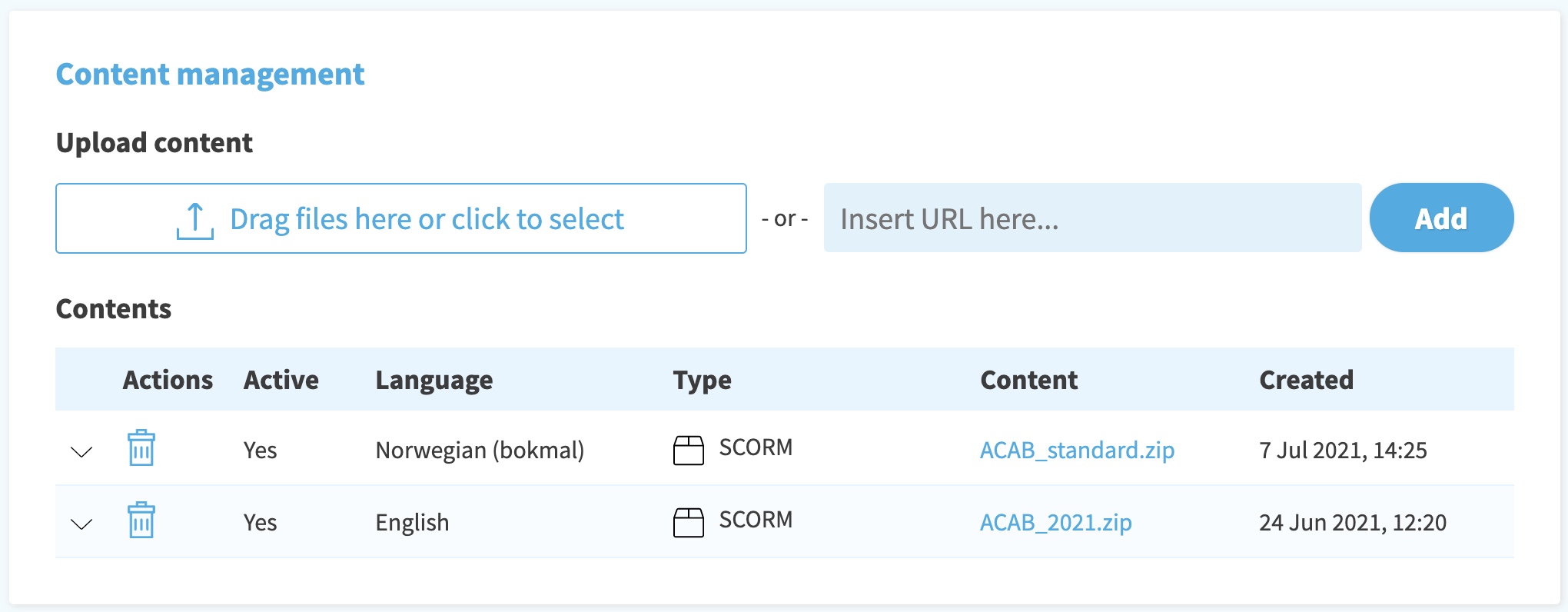
Uploaded files are listed with columns such as Actions, Active, Language, Version, Type, Content, and Created. The list is used to review files, update file metadata, download uploaded files, or remove files that should no longer be kept.
The Type value determines whether the file is treated as main content, additional material, or a source file.
When content versioning is enabled, Version identifies the content package version connected to learner sessions and reports.
Uploading materials
You can upload files or add URL-based content links.
The maximum allowed file size is 1000 MB.
Supported content formats and file types are:
- SCORM (1.2, 2004)
- H5P content selected from existing H5P records
- PDF files
- mp4 and webm video files
- links to mp4 and webm video files
- links to m3u8 video playlists (HLS and DASH are supported)
- links to external websites or documents, often in SharePoint
- Excel files (additional materials only)
- zip files (source files only)
After upload, define the file language, file type, and whether the file should be active.
For video links, Video service identifies the source service, such as raw video file, QuickChannel, Vimeo, YouTube, or DreamBroker. For video files and video links, Video projection identifies whether the video uses automatic, 360-degree, or 180-degree projection.
If a file type is not supported, use a supported format or convert the material before uploading it.
To use H5P as the main learning content, create or import the H5P activity in H5P first, then add that H5P record as content here. Uploading and maintaining .h5p packages is handled in the H5P section.
A Content tool editor training URL can also be added as main content. The LMS imports its SCORM package when the URL is added, so the content item uses the imported package rather than opening the editor page as an external link.
Material access and behavior
Uploaded files and links can include behavior settings:
- Open in new window – for link-based content or materials, opens the link in a separate browser window or tab.
- Visibility – for additional materials, controls who can open the material from the content page.
- Active – makes the file or link available where its type is used.
- Archived – hides the file or link from normal learner use while keeping it in the content record.
Additional material visibility options can include:
- Available to everyone – visible to anyone who can open the content page.
- Restrict access to enrolled users – for event content, visible only to learners enrolled in the event.
- Restrict access to participants – for event content, visible only to learners marked as participants.
- Restrict access to completed users – visible only after the learner has completed the content.
Active files
An active content file is connected to the user portal and is what the learner opens from the content page.
Inactive files can be kept for older versions, drafts, or language variants. More than one file can be active when the active files are in different languages, allowing learners to choose the language on the content page.
If there is no active content file, the content is not available to learners in the user portal.
SCORM package compatibility
For SCORM content, the tab can show a SCORM compatibility warning. SCORM variables store the package's internal state. If a package is replaced with a significantly different package, incomplete learner sessions from the previous package may stop working correctly.
Keep language versions compatible with each other. If possible, put all language versions in the same package. If separate packages are used per language, they should use the same SCORM version and differ only in translated text or other safe localization changes.
All active packages for the same content should use the same SCORM version. If a learner has an incomplete session using one SCORM version and then opens a package using another version, the incomplete session is invalidated and the learner must start again.
Use Invalidate incomplete sessions after replacing packages with incompatible versions. Invalidation keeps the old sessions visible in training activity, but they are no longer used when the learner opens the training. Sessions started with currently active packages are not invalidated.
Run invalidation immediately after replacing incompatible packages, before learners reopen the training. If a learner has already reopened it with an active replacement package, that session is linked to the new package and is excluded from invalidation even if it originally started with the old one.
Proxy packages
Proxy package downloads are off by default and require permission to manage external courses.
When proxy packages are used, the Content and Materials tab can include Download proxy for all languages and a per-language Download proxy package for this language action. Proxy packages are used for externally hosted SCORM content.
When using proxy packages, all packages for the content must use the same SCORM version. If a SCORM 1.2 proxy package has already been delivered, replacing the uploaded content with SCORM 2004 packages can make the proxy package work incorrectly.